AR Navigation in Surgery: The Key Role of CREAL’s Light Field Display
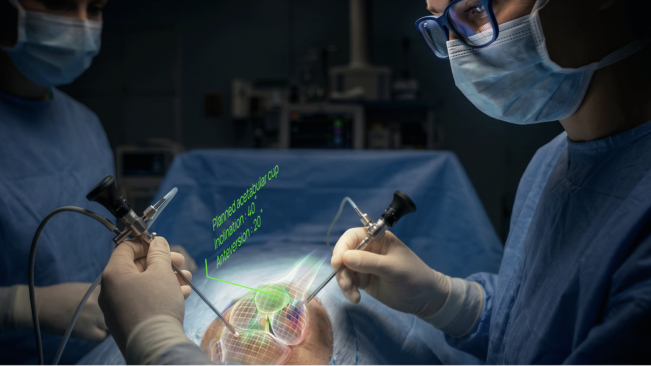
Integrated into XR devices, from glasses to headsets, CREAL’s light field display delivers a correct and natural visual experience across all applications.
While CREAL’s display technology is transformative for most AR use cases, some have more at stake than others. Applications requiring near-eye visualization or interaction with digital content — surgery, manufacturing, design, or even simply clicking menus and reading text — are currently held back by the limits of today’s displays.
The display problem
Every AR display on the market today projects a flat image at a fixed focal distance, usually around one meter or further. When the eyes try to converge on a virtual object at 30 centimeters, they are simultaneously forced to focus at the display distance. That mismatch — known as the Vergence-Accommodation Conflict (VAC) — is what causes eyestrain and nausea after just twenty minutes of use. It’s not a comfort issue, but a fundamental optical problem.
Unfortunately, the closer the content is, the worse the side effects become, as the gap between vergence and accommodation distances widens.
Adding AR contextual information to the physical environment at these close interaction distances directly exposes this fundamental limitation, even though this is precisely where wearable AR delivers its greatest value. Most compelling AR use cases rely on contextual information, guidance, and interaction within arm’s reach — the very range where the VAC is most severe.
Unlocking AR navigation in Surgery
AR navigation in surgery is both one of the most promising and most demanding applications of this technology. Visual precision and user comfort aren’t nice-to-haves — they’re mission-critical. This is what brought CREAL and Ferdinando Rodriguez y Baena, Professor of Medical Robotics at Imperial College London, to start an exploratory research partnership, focused on developing XR solutions tailored to the surgical environment: accurate depth perception, spatial alignment between virtual and physical anatomy, sustained visual comfort, and clinical reliability.
Professor Rodriguez y Baena states it directly:
“From where I sit, XR is the future of surgical technology, and its widespread adoption is simply inevitable. Current mature augmented‑reality solutions, whether video see‑through or optical see‑through, remain fundamentally unfit for purpose in demanding surgical environments. CREAL’s unique combination of dynamic focus, high-resolution fidelity, fast refresh rates, and an appropriate workspace truly hits the sweet spot for surgery, and I cannot wait to see the next-generation surgical headset become a reality.”
If you’re interested in exploring with CREAL’s light field display solution, we’d love to hear from you: info@creal.com